
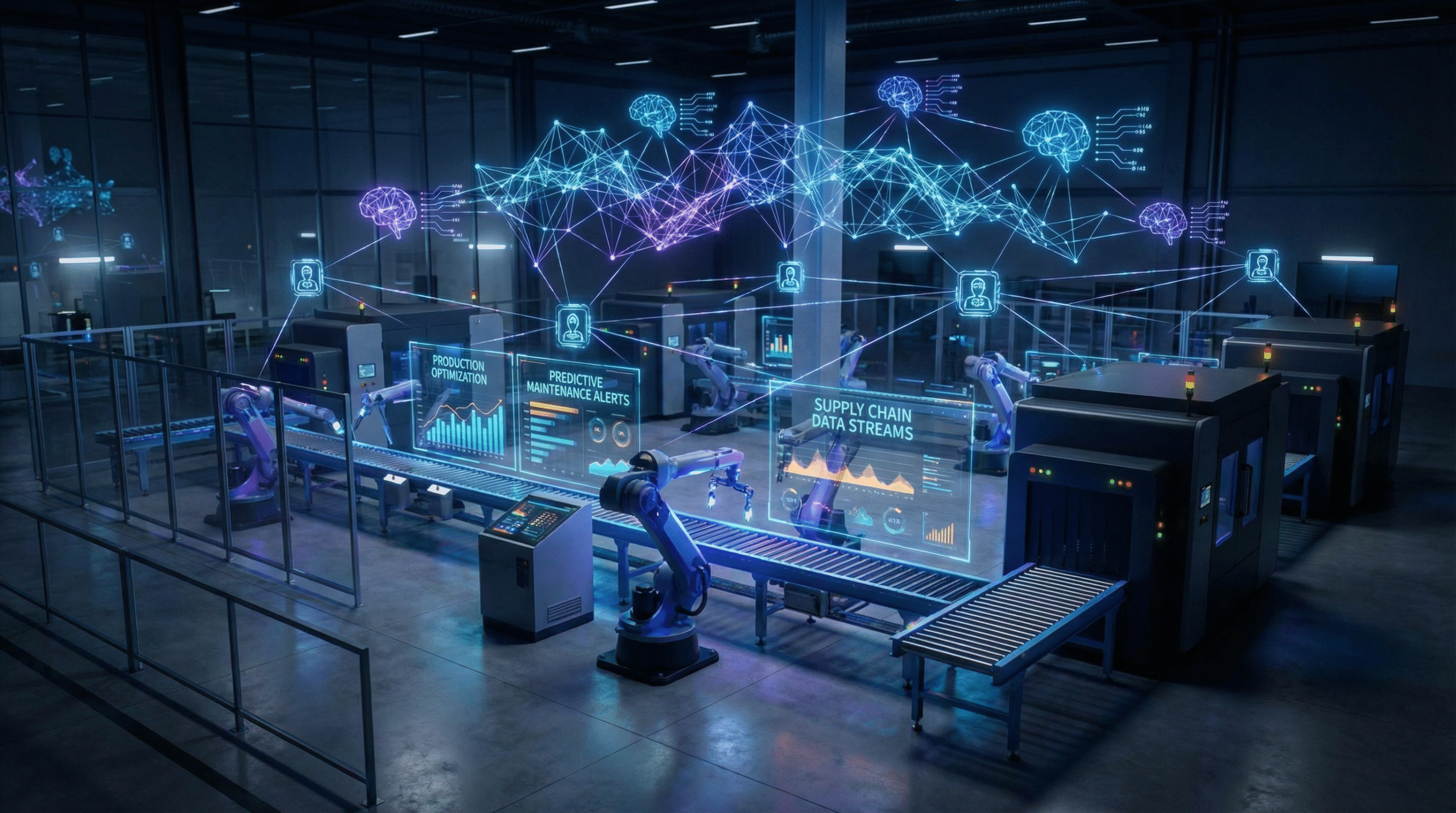

Manufacturing is moving to a stage where efficiency is no longer sufficient. Intelligence itself is becoming autonomous as factories get more networked, automated and data driven. This change runs on agentic AI systems, where the machine does not just analyze the data but takes action on its own. The concept of agentic AI is changing the way contemporary manufacturing is performed and reacts to changes and evolves in the framework of Industry 4.0.
Consider a production floor that is running late at night. Machines are going to be run to capacity, supply chains will be self-adjusting and an anomaly of a minor vibration in a key machine will be detected immediately. An AI agent also detects and addresses the problem before it becomes noticeable by placing the order of replacement parts, setting the production schedule to reduce losses caused by down time and scheduling the maintenance operation. In operation, this is not a vision of the future, but agentic AI.
Long ago, the automation was regarded as the climax of industrial development. However, the traditional automation was fixed and responsive. Systems were programmed and they worked around definite rules and failed when something unforeseen occurred. The intervention of humans was always needed, which was expensive in terms of time, money, and operational stability. The agentic AI is a complete break with this model. It does not wait. It learns, reasons, and acts.
The difference between agentic AI and other AI.
The majority of contemporary factories already are using AI-driven knowledge. These systems gather data, make reports and identify trends. Then they end at recommendations. The further step that agentic AI makes is by bridging the gap between insight and action.
In contrast to the traditional AI, agentic systems are aware of context. They strike a balance between several variables at the same time and create complicated workflows without supervision all the time. Rather than simply informing the teams that a machine would require service, agentic AI can arrange maintenance, liaise with suppliers, rerouting production, and keep records to ensure compliance. The outcome is a manufacturing environment that evolves in real time as opposed to responding once disruptions have been experienced.
This freedom gives manufacturers the opportunity to control global supply chains, to optimize the use of energy on an individual basis, and to set quality standards which would otherwise be susceptible to many manual interventions.
Why 2025 Is the Turning Point
The advent of the increased attention to agentic AI in the sphere of manufacturing is not a coincidence. By 2025, technology will be no longer at the experimentation stage. It has become feasible, effective and cost effective.
The leaders of the industry, including Siemens, have shown that AI agents in the industry could provide productivity gains of up to 50 percent. These are transformational gains and not incremental. Meanwhile, manufacturers are under growing pressure of qualified labour unavailability, the more complicated chain of supply, the tougher environmental policies and more demanding customers.
Failure cost has also gone out of proportion. One of such stoppages in production lines may cost the organization hundreds of thousands of dollars an hour. Large-scale recalls are initiated by quality defects, whereas supply chain disruptions may make operations come to a halt. In such a setting, reactive systems cannot be satisfactory any more. Independent intelligence is something that is required.
The Way Agentic AI is Transforming the Manufacturing Process.
Production optimization is one of the closest effects of agentic AI. The classic production lines are based on the parameters established by engineers, although real-life conditions do not always stay the same way. The quality of raw materials is fluctuating, demand also fluctuates and performance of equipment also changes with time.
An agentic AI considers each moment as an optimization possibility. It constantly varies the machine speeds, temperatures, pressures, and sequencing using real-time sensor data. In case of deviations corrections are carried out immediately. Companies that have implemented this strategy have stated that they have decreased material wastage and also achieved a significant increase in equipment effectiveness, as well as an increase in speed of reaction to disruptions.
There is also agentic AI that has developed to predictive maintenance. Traditional systems are based on simplistic thresholds that will result in an alert on exceeding limits. Instead, agentic AI interprets vibration, thermal, acoustic, power, oil, and historical performance at the same time. It realizes that what is normal in one machine is not the same with the other machine.
Better still, it does something about these insights. Once the first warning of wear is detected, the system arranges maintenance at the most convenient moment, orders, arranges crews and prepares work instructions- often before the operators notice that there is a problem. Infrastructure with this strategy has substantially lowered downtime and operational expenses.
Other transformation areas include supply chain orchestration. The contemporary supply is characterized by hundreds of suppliers and thousands of SKUs in different regions. Human planners tend to make decisions based on old pieces of information. Real-time Agentic AI is used to track inventory levels, demand indicators, supplier performance and logistics disruptions. When the delays arise, it tests alternatives, re-calculates the effects of production, and instigates contingency plans instantly. The outcome is reduced costs of inventory carrying and significantly reduced inventory shortages.
Competitive Advantage of Energy Intelligence.
The cost of energy contributes a significant amount to the cost of manufacturing, though lots of facilities continue using manual controls. The management of energy is regarded as a continuous optimization problem by agentic AI. It integrates HVAC systems, compressed air, process heating and machinery according to production schedules, energy pricing, weather forecasts and equipment efficiency.
Manufacturers who have utilized agentic energy management have been able to make significant savings in terms of energy used, yet the resulting output remains unaffected. Such gains are reflected directly in the form of reduced emissions and huge cost savings, and they do not compromise productivity.
The Mendygo Perspective
At Mendygo we base our agentic AI on a simple notion that the best technology operates in the background. We have AI systems using the Internet of Things that are not just data collection mechanisms but rather data action systems. Our platforms optimize operations on efficiency, reliability and cost control, whether it be intelligent building management or supply chain intelligence.
We have assisted manufacturers to avoid spoilages, reroute temperature sensitive shipments on-the-fly, and prevent losses that would not have been realized otherwise. They are not some hypothetical promises but practical results achieved with the help of autonomous intelligence.
Looking Ahead
Manufacturing is going to be autonomous, adaptive and collaborative. Millions of operational decisions will be performed by agentic AI in real time, leaving humans to concentrate on the strategy, innovation, and solving complex problems. This is not regarding to substitute people- it is about allowing them to work at a superior level.
Manufacturers taking agentic AI today are not simply making processes more efficient. They are developing resilient operations that would be able to succeed in an ever-complicated industrial environment.
Are you ready to embrace agentic AI? Contact Mendygo to find out how our AI built on IoT can future-proof your manufacturing.
Leave a Comment