
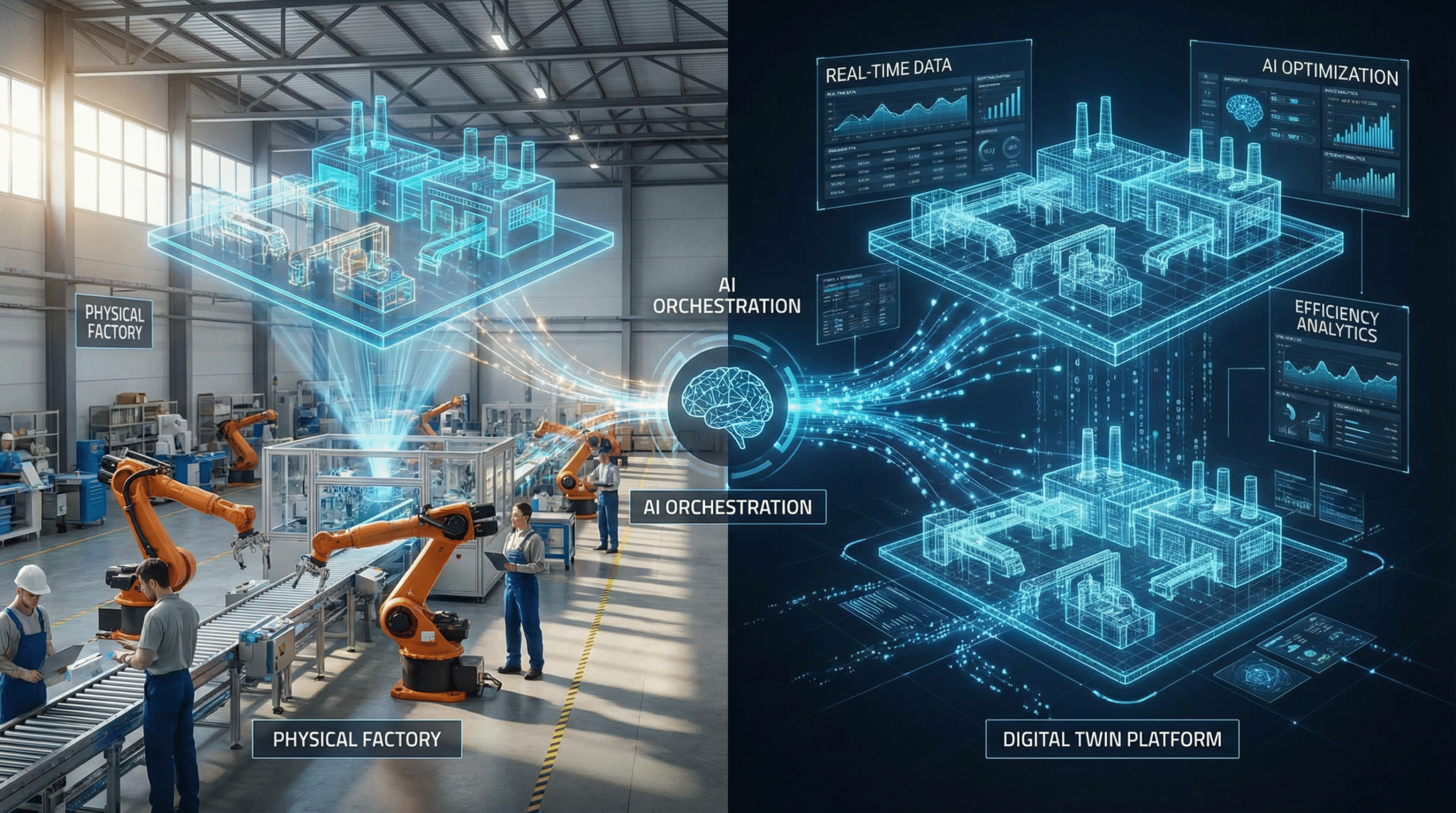

Digital twins have been employed as advanced reflections of the physical ones over the years. Simulation of performance, test situations, and inefficiencies A digital simulation of factories, buildings, and supply chains in digital form was implemented. The initial applications provided value, but were still much in the way of a passive application. They saw, prophesied, and counselled-but did not.
That is changing rapidly.
Digital twins 2.0 will be a transition whereby in the past, digital simulation tools are the type of tools that are simply used in just one manner or the other, but now, the digital twins are active and autonomous systems that are used to continuously optimize the operations in real time. Digital twins are not as simple as a copy of the real thing anymore in the times of Industry 4.0. They are becoming players in it.
Passive Models to Living Systems.
Conventional digital twins were most often analytical. Under given conditions, engineers had the opportunity to simulate the behavior of equipment, test other design changes, or even predict failures. Although helpful, these models were very much reliant on human interpretation and human intervention. Ideas were created, but operators needed to take some action.
Digital twins 2.0 overcome this constraint.
Modern digital twins are part of the physical ones and constantly developed through real-time data streams, advanced analytics, and autonomous intelligence. They are not merely the reflection of what is happening: they perceive it, internalize it, and act in response to it.
Rather than an engineer looking at a simulation, a self-sensing digital twin has the capability to identify inefficiencies, tune parameters and effect optimization automatically. The twin forms a choice making layer that is incorporated in operations.
The reasons why Digital Twins 2.0 is becoming momentum now.
Digital Twins 2.0 has increased its relevance due to a number of converging factors.
First, industrial environments have been made very complicated. Contemporary plants and constructions entail thousands of assets and sensors as well as systems that are interconnected. Man-made optimization cannot keep pace with this level and pace.
Second, live information has been enhanced. The physical assets are currently linked to the digital worlds through continuous data flow using IoT platforms, edge computing, and cloud infrastructure.
Lastly, there is the shift in expectations. Organizations are no longer interested in tools which simply diagnose. They desire systems that do not cause problems, change automatically and enhance performance without vigilant management.
Digital Twins 2.0 addresses such needs by being decision execution instead of decision support.
Autonomous Optimization at Work.
Autonomous optimization is one of the most effective uses of Digital Twins 2.0.
Digital twins also constantly track machine behaviour, energy consumption, throughput, and quality indicators in manufacturing settings. On a change in circumstances, including changes in the raw materials, changes in demand, or aging of the equipment, the twin automatically changes operating parameters to keep the performance optimum.
Likewise, digital twins control HVAC systems, lighting, energy loads, and environmental conditions in buildings and other infrastructure. Systems are dynamically responsive instead of operating by fixed schedules and react to occupancy, weather, and energy pricing conditions in real-time.
Supply chains are also enjoying the advantages. Disruptions to logistic networks are modeled virtually in the digital twins and re-optimization of routes, inventory location, and delivery times is performed in real-time. This minimizes the delays, minimizes the costs and enhances resilience without having to wait to be attended to by manuals.
Mendygo View of Digital Twins 2.0.
In Mendygo we can observe Digital twins 2.0 as operational intelligence, rather than visualization tools.
Our solution aims at developing virtual models of buildings, factories, and supply chains that are closely connected with real-time information and self-directed decision-making opportunities. These virtual twins are not the models of performance, but the real performance optimizers.
As an illustration, an online replica of a production plant will be able to continuously optimize its energy production, efficiency, and equipment well-being. In case of inefficiencies, the system does not just give alerts. It automatically modifies the performance without compromising on performance and compliance standards.
In supply chain settings, the digital twins at Mendygo foresee the disruption in the supply chain before it is too late. With constant logistics information, environmental conditions, and demand signals, the system is able to adjust the storage, routing and scheduling before they occur, reducing waste and preventing expensive delays.
Going Beyond Optimization to Self-Learning Systems.
The capacity to learn is what is actually special about Digital Twins 2.0.
Since these systems work, they can store contextual information regarding the behaviour of assets in various situations. In the long term, this learning allows making more accurate predictions and more accurate optimization strategies.
This self-directed learning ensures that digital twins are able to change with operations. The smarter and more efficient they are the more they work. This in itself gives it a compounding advantage, which cannot be duplicated by a static system.
A Practical Path Forward
Digital Twins 2.0 does not necessarily necessitate re-implementation of operations. Its best implementations begin with a narrow use case, meaning energy optimization, predictive maintenance, and logistics orchestration, and grow over time.
It is based on the same: trusted data infrastructure, effective governance, and belief in autonomous systems. Digital twins improve human decision-making and not oust it when implemented intelligently.
Looking Ahead
Digital Twins 2.0 is a paradigm change in the functioning of industries. They are the beginning of the transition between the observation systems and the intelligent and autonomous running thereof.
With Industry 4.0 constantly developing, the organizations that will gain more than efficiency will be the ones adapting to autonomous digital twins. They will become flexible, resilient, and able to optimize continuously because the circumstances in the world will never stay the same way.
Digital twins no longer have a simulative future.
It involves optimizing systems which are real world drivers.
Leave a Comment