

The last time you checked your factory’s energy consumption, the data was probably already outdated. By the time you noticed a spike in power usage, your equipment had already made hundreds of inefficient decisions—and the damage was done.
This is the problem with traditional energy monitoring. It tells you what happened yesterday, but it can’t help you make better decisions today.
Why Real-Time Matters in Energy Management
Consider the way your facility is being run. One of the motors begins to consume unwarranted energy at 9:15 AM. When there is a change of temperature, your HVAC system overreacts. A compressor starts operating inefficiently among loads. They occur on a regular basis- but the conventional monitoring systems can only pick them up after every month review of bills or quarterly audits.
The latency is not only inconvenient. It’s expensive. Any hour of inefficiency that goes unnoticed is a squandered energy that you will never be able to retrieve.
The nature of this is transformed by modern IoT-basis energy management which tracks your operations real-time and notifies you when something goes wrong not in weeks when you are working with spreadsheets.
From Periodic Reports to Continuous Intelligence
The conventional energy management was based on manual meter readings, monthly energy bills, and energy audit annual. You were aware of what you were getting in quantity, but you had very little information as to when, where and why that intake was taking place.
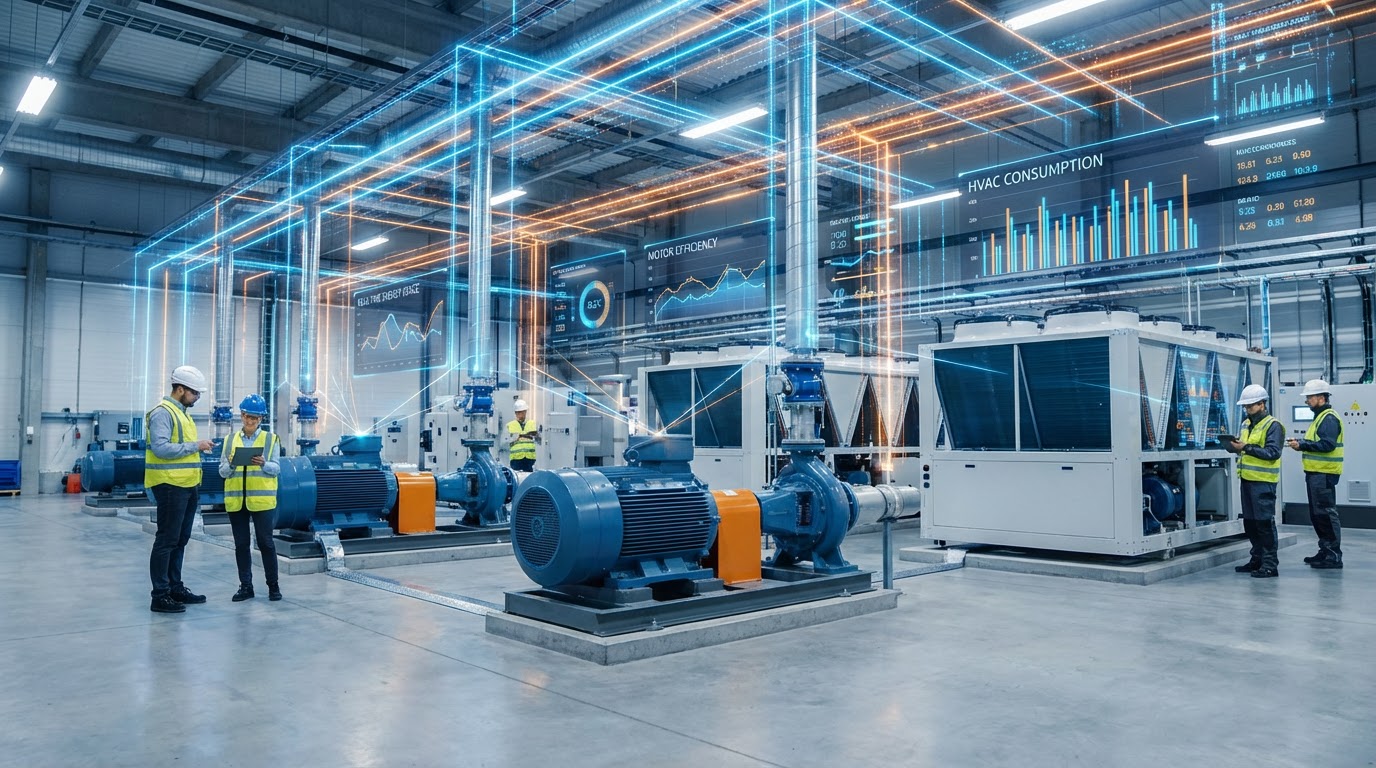
This model is reversed by IoT-driven systems. Your facility has sensors across the board to monitor power usage on an equipment level. Not only at the main meter, but at separate machines, production lines, heating and air conditioning units and auxiliary systems.
Patterns that are not found in data aggregation are identified in this granular visibility. You find out that there is always 8 percent more power consumed by one production line compared to the same lines. The north wing is overcooled by your HVAC system all day afternoons. There is a motor that consumes undue current during start-up periods.
These enlightenments are present in your plant as of today. They can simply not be detected by most energy management systems.
The Bandwidth Reality
Data volume is a new issue due to continuous monitoring.
As you follow hundreds of assets through a facility, motors, switchgear, APFC panel, gensets, busbars, important loads, you make vast amounts of information. The old-fashioned systems cannot handle this amount, and this makes it a bottleneck that slows down the insights you require.
Effective systems of energy management refine this data effectively, removing noise and revealing useful intelligence. Raw sensor values remain in the system where they belong in the system in an analytical engine. Instead of being bombarded with unfiltered streams of data, you are alerted, shown trends and suggestions.
What This Means for Your Operations
The Energy Management System of Mendygo implements the same in the energy infrastructure of your facility. Rather than waiting till after a month, you get to see how things are going during consumption in real time.
Active Energy Monitoring measures the power used by all sources, including mains power, solar power, wind power, gensets and compares the actual usage to the rated performance to identify any anomaly in real time.
Load Analysis discovers usage patterns between machines and departments, and can be used to make smart scheduling to minimize peak demand charges and maximize the use of equipment with high consumption.
Predictive Alerts indicate anomalies in time. The system tracks the temperature of the switchgear, health of busbar, APFC panel and genset performance alerting maintenance staff when their parameters move beyond the normal ranges.
Shield Analytics prioritizes issues depending on impact, which allows the teams to concentrate on the challenges that really matter instead of pursuing each and every nuance.
The outcome: you are not only monitoring energy but are actually being pro-active with it.
Data That Supports Better Decisions
One aspect is solved by real-time visibility. However, energy management is not merely knowing what is going on but what the reason is and what should be done about it.
This requires context. A 10 percent power spike can be expected in the early stages of production but alarming in the steady-state scenario. A fluctuation in voltage may represent a faulty piece of equipment, or merely a condition of the grid that you have no power over.
These scenarios are different under intelligent energy management systems. They get to know your normal operation patterns in a facility and filter out real problems and sort out the anticipated differences.
In the case of multi-site operations, this will be even more beneficial. You are able to compare performance between places, discover what is making best practice in your most productive plants and apply the same elsewhere.
Keeping Operations Data On-Premises
The industrial facilities produce sensitive data with regard to operations. Production schedules. Equipment performance indicators. Patterns of energy consumption that are illustrative of your competitive positioning. Most manufacturers tend to retain this information in their own hands as opposed to being fully dependant on outside cloud services.
This is approached using the flexible deployment models in modern energy management systems. The most important operational data can still be kept within the premises as well as allowing the analytics and reporting features you require. You are in charge of sensitive information and at the same time become intelligent so that performance is maximized.
The Multi-Site Challenge
Energy management becomes even more complex in case of organizations which have a number of facilities. Every location possesses its own equipment, disparate production timetables, disparate rate designs of utility, and dissimilar operation crews.
It becomes necessary to have centralized visibility. You should know performance in different geo-locations, locate outliers, both negative and positive, and normalize best-practice. However, you will also require local teams in order to tap the local knowledge applicable in their operations.
Both sides are available in the platform of Mendygo. The operations teams have site-based dashboards with their equipment, consumption patterns, and actionable alerts. The management gets a sort of a bird-eye view of the strategic decision making, performance benchmarking and resource allocation.
Making Energy Management Practical
Complete energy monitoring does not involve massive infrastructure changes. The new systems combine with the existing equipment and are linked to the existing equipment with sensors and meters.
Begin with high-impact areas Equipment with the highest power usage, systems that are likely to be inefficient, or assets where getting the most out of them yields immediate returns. First of all deploy monitoring there. As these implementations are proven to be value addition, it becomes easy to expand.
The modular approach of Mendygo indicates this fact. You are not obliged to commit to facilities wide initially. Rather, you apply the targeted capabilities that solve your urgent requirements- be it genset optimization, APFC panel monitoring, load balancing or end-to-end energy analytics.
From Reactive to Proactive
Classical management of energy was in response. Issues were identified by the unexpectedly high bills, equipment failures or manual audits, which identified issues weeks after they started.
The contemporary energy management is active. Problems are raised when they occur. Before they get compounded, inefficiencies manifest themselves. The maintenance crews are alerted on actual equipment behavior and not on arbitrary timetables.
It is not only a cost savings initiative, but this change of course will avoid the gradual loss of efficiency that usually leads to significant issues. A motor that is consuming 3% overcurrent is not breaking yet, but is heading that way. Early detection implies that you maintain it when you have downtime and not when there is an emergency shutdown.
The Energy Management Evolution
The fundamental question has changed.
Energy management used to ask: “How much did we consume last month?”
Now it asks: “How efficiently are we operating right now—and what can we improve in the next hour?”
This shift from historical reporting to continuous optimization represents more than incremental improvement. It’s a fundamentally different approach to managing one of your facility’s largest controllable costs.
For manufacturers operating in competitive markets with volatile energy prices and increasing sustainability pressures, this capability matters. The facilities that optimize energy consumption in real-time gain advantages that compound over months and years.
The technology enabling this exists today. It’s proven, deployable, and delivering measurable results in industrial operations across sectors.
The question isn’t whether intelligent energy management will become standard practice. It’s whether your organization will adopt it early enough to capture the advantages—or spend years playing catch-up while competitors optimize ahead of you.
Mendygo’s IoT-driven Energy Management System provides the visibility and control needed to transform energy from a fixed cost into a managed variable. From real-time monitoring to predictive analytics, see how intelligent energy management works in practice.

Leave a Comment