
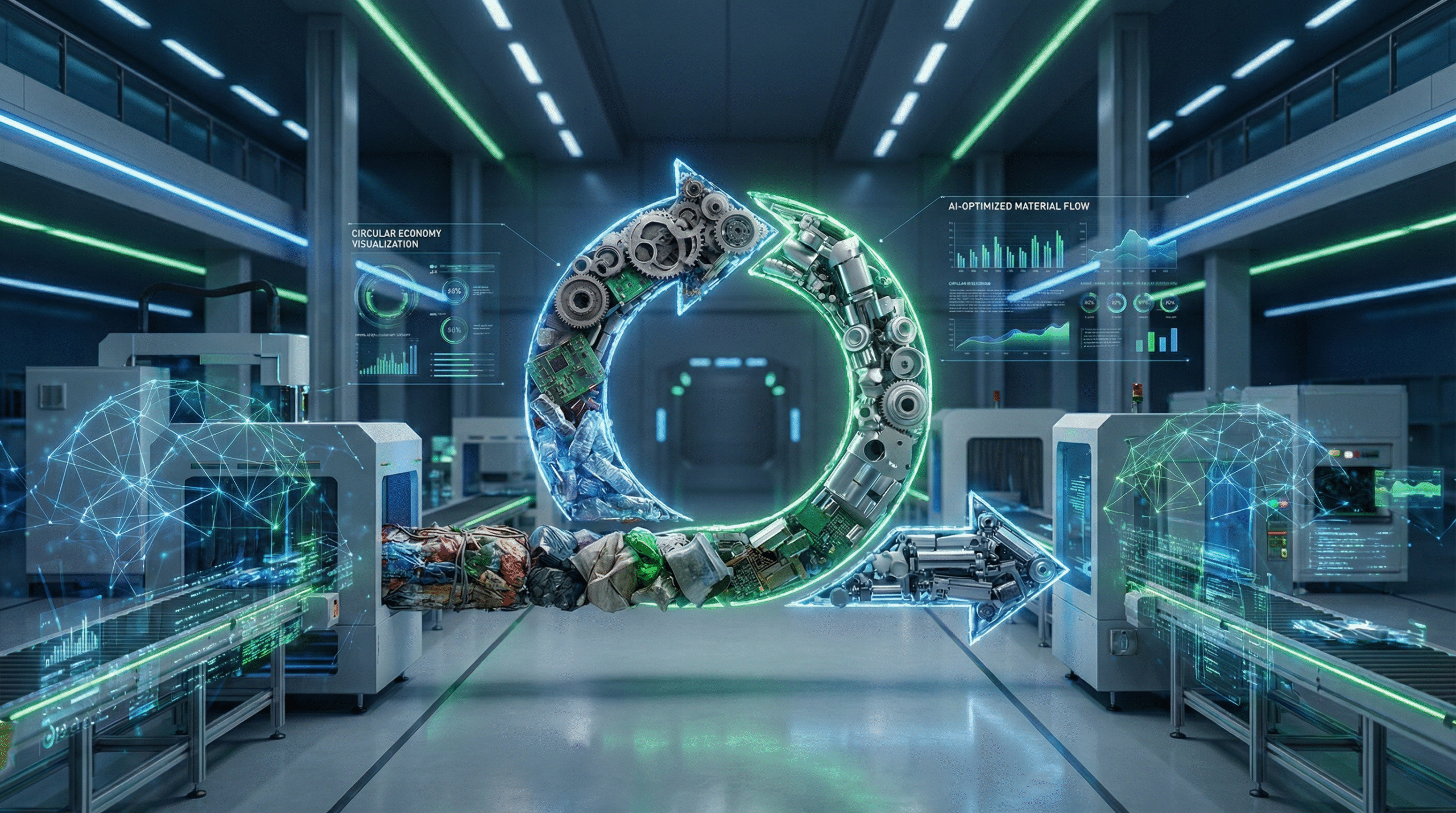

There is a peculiar contradiction in the manufacturing industry. As global material costs remain on their increasing trend of up-to-date prices of raw material have been raised on average by 23 cents since 2020, factories all over the world end up throwing material worth about half a billion dollars a year. This is a paradox that is the biggest challenge of the industry as well as the biggest untapped opportunity.
The latest studies point out that manufacturers that have implemented the principles of a circular economy can reduce their costs by up to 67 percent and can decrease their environmental impact by 72 percent at the same time. However, it is still adopted with a low rate. The obstacle has not been consciousness or will. Instead, the difficulty of monitoring material movements, optimization of recovery, and closed-loop systems has previously surpassed the ability of humans to operate. Artificial intelligence is altering that formula.
The Economics of Linear Thinking
Conventional production is based on a linear system: extract, produce, use, dispose. This was economically viable in situations where raw materials were cheap and in plenty, labor was costly and disposing the waste was cheap. Such circumstances are no longer there. The current manufacturers are challenged by the uncertainty in the supply chain, waste management regulation and customers who insist on sustainable business practices. The way the economy is is changed fundamentally and the operational models have not yet adjusted.
Take into account the auto industry. Manufacturers put that about 15-20 percent of the raw materials bought are left into finished products. In the case of a mid-sized plant that handles a use of materials in the tune of 100 million every year, this translates to 15-20 million in direct losses- excluding disposal costs, regulatory charges or reputation damage. Extrapolating this throughout the manufacturing base in the world is a hundred-billion dollars opportunity.
Where AI Creates Value
Artificial intelligence is changing circular manufacturing not only into a dream but also into a strategy that can be put into action in three different ways: lifecycle intelligence, material recovery optimization, and closed-loop coordination.
Lifecycle intelligence commences at the phase of design. AI systems compare product specifications with material databases and determine the possibilities of replacing virgin materials with recovered materials without impairing the performance or safety level. A single electronics producer whose AI-based material selection decreased the expense of the raw materials by 18 percent and adhered to all criteria and standards. The system determined twelve material replacements that were by no means viable to human engineers.
Material recovery optimization resolves the operations issue of locating, sorting and utilizing waste streams. Sophisticated computer vision systems are currently capable of identifying materials with a high accuracy of above 90 as opposed to 60-70 percent in manual sorting processes. This enhancement is directly proportional to financial results. An AI sorting system used by a plastics processor boosted the material recovery rates by 62-91 percent, and created extra material recovery value of $4.3 million per year.
The most complex application is called closed-loop coordination. These systems monitor the materials in their whole life-cycle- starting with the purchasing of materials, the manufacturing of the products, the utilization of the same and finally recycling of the same materials. IoT sensors detect the state of the products in real-time, AI algorithms decide the best time to recover products, and automated systems facilitate logistics. A construction equipment maker that used this strategy saved 34 percent in the cost of inventory carrying and saved 41 percent in material waste.
The Implementation Reality
The economics of AI-driven circular manufacturing is very tempting, but the deployment should be thought over. According to Bain research, more than three-quarters of manufacturing executives think circular solutions will increase revenue by 2027, but they cannot succeed without addressing three key factors.
To begin with, real-time material tracking has to be supported by data infrastructure. This necessitates IoT sensor networks that will be able to track the material flow during the production and product lifecycle. Second, AI models require training data that represents your materials, processes, and products. Copycat solutions are very unlikely to have the best results. Third, the structures of organisations should change to embrace circular thinking; procurement, production and product design teams should have common motivation and metrics.
From Concept to Competitive Advantage
According to the estimates of the World Economic Forum, it is possible to state that by 2030, the benefits of the approaches of the circular economy will reach $4.5 trillion. To an individual manufacturer, the opportunity is short-term and quantifiable. According to the McKinsey analysis, sustainable manufacturing practice can save the operational costs by 20 percent and at the same time build the brand value and customer loyalty.
Circularity should not be seen as an environmental initiative, but rather as a fundamental operational approach of the manufacturers that have acquired the competitive edge in the present day due to the power of artificial intelligence. They have been turning waste streams into profit centers, they are making their supply chains less vulnerable to failure by recovering materials and they are creating resilience into their operations.
The vicious cycle of manufacturing is turning itself around. The issue is: will your organization be the first to undergo this transformation or will you be in the images of other competitors that were more responsive. The technology exists. The economics are proven. Execution is the only variable.

Leave a Comment